St Croix River Road Ramblings

Welcome to River Road Ramblings.

Monday, December 15, 2014

Cleaning (and Building) the Cellar

The Olsen oil furnace has been smelling like kerosene when it runs for the past week or so.  Time for maintenance call.  I called a few months ago, and the man didn't show up, but the oil smell then disappeared, so didn't really mind.  
The way-too-steep basement stairway.  Mrs. John Nelson fell down it one time (she had 21 kids in the house her husband built for her),  Originally, a tip-up floor tipped back so it covered the stairway and made this area under the stairway going up to the upstairs sort of a walk in closet.  But it was unreliable (I think that was how Mrs. Nelson fell) and never used by the Hansons. 
With Margo somewhat delicate from the back surgery (she is doing good, starting to walk without walker or cane some of the time), and the smell coming back, called again.  The furnace man apologized and said he would be out this afternoon.  

As it is mild outside and raining, I opened up the outside basement stairway door and started hauling out some of the junk.   Got about 1/4 of the basement cleaned. Mostly old dishes, magazines, newspapers, bank statements, clothes that mice had rummaged through.  

 Full of cobwebs and signs of the red squirrel who had moved in this summer -- chewing on black walnuts and messing up some of the insulation.   Two days ago, I shot the 3rd red squirrel that came up by the house.  I am hopeful I have got them all -- I think they made about 4 different entrances into the basement and then up an interior wall, across the ceiling between downstairs ceiling and upstairs floor and into the living room wall.  Trapping failed, but I pinged them with 22 shorts from my single shot Western Field, $14 from Wards in 1960.

As I was cleaning (about 1/4 down), I noticed the east wall had a water leak, the cement wall cracked here and there, and lots of junk to get rid of.  In her younger days, Mom had the basement in great order, but as she got older she let it slide -- too steep of stairs to get down and so sent her grandson's with what should have been tossed or recycled or junked and stored it in the basement. 
Digging a basement--not Hanson farm

Scraper to move dirt
Emil Nelson was a kid when the house foundation and basement was dug (1917).  He said he "helped."  One team pulled a walking plow with a man to make furrows and loosen the hard red clay and another pulled a scraper to drag out the loose clay.  Emil rode the horse that pulled the scraper.  


Too loosen the dirt in the hole for the scraper, a walking plow cut furrows.  (This is not at the Hanson Farm!)


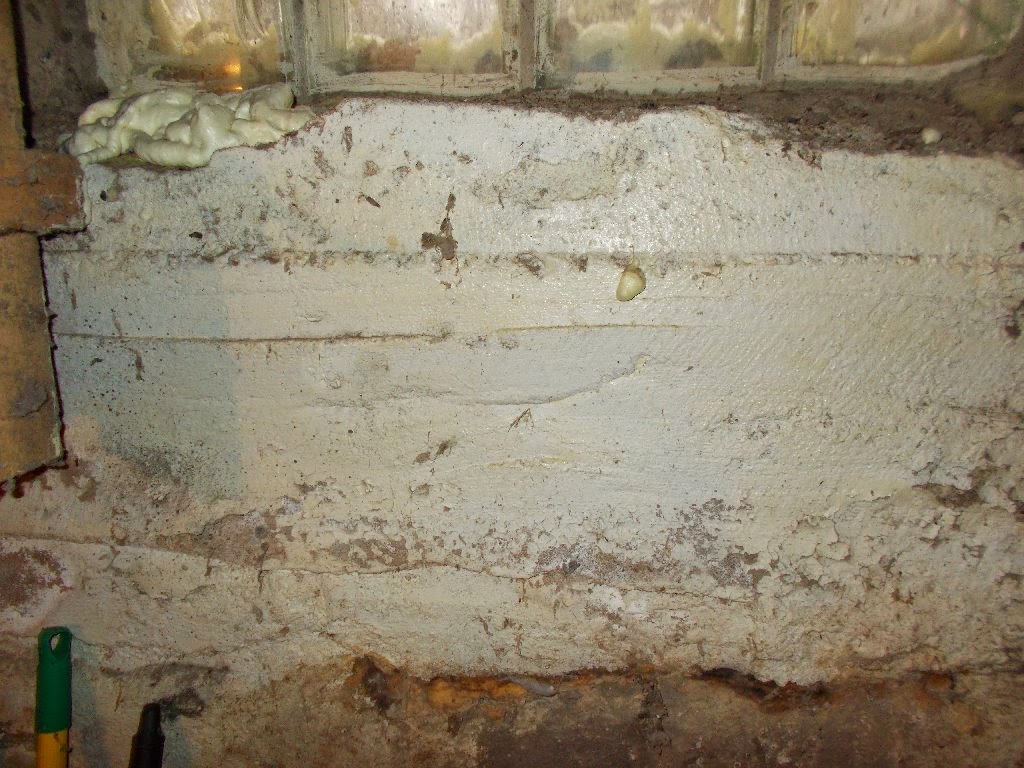
The old concrete walls show the imprint of the board forms.  Dad put in glass block windows and Mom had it whitewashed in the 1950s.  Sort of cracked and crumbly after the 1st 100 years, probably only last for another 100. 
To dig a basement this way made a much larger hole than needed, but it was "mechanized" better than digging it all by hand.   The concrete basement walls were poured with board forms, leaving their imprint on the walls.  In one corner is the charred ceiling where Ole Olsen's moonshine still blew up and burned the joists and ceiling boards.    Mom, disliking dark rooms, had Dad whitewash the whole basement making it brilliant white for a time.  
The basement was where all the canned good were stored on wall shelves.  A colder area kept potatoes, apples, and other root crops.  In the fall, 2/3 of the basement was filled with split firewood to feed the massive round furnace.  Dad put a copper line inside the furnace that ran to a metal water tank (like a hot water heater tank) so we got free hot water from the furnace heat coil.  The water was gravity feed from a 100 gallon water tank in the upstairs filled with an overhead pipe running from well house to the house.  
Dad did his own plumbing and never let looks get in the way of a straight shot for his plumbing.  Here the sewer line went in front of the canning shelves.  They are filled with junk!  Originally all cast iron with lead poured joints, one section is replaced with plastic line now.  Old lantern on the floor.  
Also in the basement was the small wood water heater, used in summer when the furnace was cold.  On washing day, we fired it up and heated 20 gallons of hot water for the Maytag washer--sometimes kept in the basement too.  

Originally, when Dad moved here in 1941 (married 1942), the basement had a dirt floor.  In the 1950s, we borrowed Grandpa's cement mixer, a few wheel barrows, hauled gravel from the Gullickson pit, and with a crew of Dad's brother's poured a complete concrete floor in a day.   Sometimes I got to mix--think it was 3 scoops of gravel for 1 scoop of cement mix, add water until it was soupy.  Quite fun for kids.

In the late 1940s, Harvey Olsen of Cushing ran electrical wires across the basement and up the walls to have 4 circuits in the big house.  In the 1950s Dad add indoor plumbing adding pipes and sewer lines here and there.  The wood furnace was replaced a couple of times and finally about 15 years ago the oil furnace replaced wood.  We tried to get Mom to go for a cheaper running propane furnace, but she was sure it would blow up, so the oil furnace is in.  I think fuel oil (#1) costs about 3-4 times as much as propane this year and requires much more furnace maintenance too. 


The brick chimney seems sound. Dad had a stainless steel square liner put in when he began to worry about chimney fires.  We did have chimney fires occasionally when I was young.  Dad would scramble up a ladder onto the top of the roof and sprinkle snow down the chimney as we shut off the furnace draft.   Never called the fire department for something like that.  They might pour water down it and crack the blocks -- sprinkled snow worked much better.
  

A wet spot today on the east wall near the north window--today's rain must be leaking in.  I have to do some landscaping around the house to slant the water away next summer.

Carrying beam north-south -- squared logs

Looks like Jed Hanson did some patching for Grandpa and Grandma!


The old Maytag.  Note the electric motor is gone.  Any spare electric motor went to run a grinder or other tool in the workshop!  Brother Ev has a genuine Maytag 1 cylinder gas engine I maybe could put on here to go off the grid!  Piled in with junk around it.

Old kerosene heater or two burner stove?  Update:  the furnace repair man took this home with him.  His grandmother had one for the summer kitchen, and he felt the urge to rescue this rusty two burner stove.  Note the green kerosene jug on the left!   New Perfection wick burners with isinglass. 

Do it yourself plumbing when you try to save money on pipes and copper is often cobbled up as they say in the country. 

This was once lath and plaster on one side (fartherest in) where paneling went over it and wainscoting on the other torn off to access the sink drain.  The lumber in this house was much from recycling an old log house and another old frame house.  


Cleaning out a basement is not all drudgery -- it is a good rainy day job and a little bit of a treasure hunt wondering if anything you find is actually worth saving.  In one corner is a walled in 6x5 sort of closet that was originally our photo darkroom, but got converted to the cold storage room for spuds, canned goods, and so on.  It still has canned goods from the 1990s that I have to take out and dump and clean the jars including about 20 quarts of a bad tasting batch of maple syrup from 1996 that we bottled, but never cared to use!   I opened one and tasted it, and age has not improved the flavor. 

Update:  The furnace repair man showed up, replaced the nozzle, cleaned here and there, cast a few spells and said call me if it still has problems.   Possible problem:  solenoid that shuts off the fuel line when the furnace stops might drip a little and that could cause some oil smell when starting. Otherwise it is a relatively new furnace with all the parts replaceable.   He admired the New Perfection two burner stove so much, even with the layers of rust and neglect, that I sent it home with him.  My brother's didn't want it -- I bet they missed out on a real treasure!   At least I think it will get repaired and used now!


Thursday, December 11, 2014

The Young Stock Barn Gets Attention

The Young Stock Barn

In the 1950s with the war over, the farm paid off and 4 boys (born 44,46,48 and 51) and Dad just turning 40, it was time to expand the farming operation.  First the barn got a new cinder block foundation and a Grade A milk house along with some inside improvements to house 24 cows and the horse barn attachment pulled down (it was in rough shape). 
Sixty years old and in need of some work


A box elder tree is invading the barn.  Although box elders are not great firewood, they are OK--actually in the maple family.  I don't use them to cook maple syrup, as that would be too close to cannibalism.  

One branch is lodged on the roof--will be tricky to get off.  I guess some chainsawing on the roof is in order. 


Grade A regulations required that calves couldn’t be tied along the walkways behind the cows, so that meant a new building for calves.   As in all building projects on the farm, they started with identifying some trees suitable for sawing into lumber.  The cow pasture, ½ mile up the road had some American Elms and basswood big enough for boards, even though in 1949 Dad sawed out a few thousand feet of elm and basswood for the garage/granary. 

Although Grandpa Pearl Hanson had a two-man chainsaw co-owned with Earl McLean (I think), Dad didn’t have help so he cut them down himself.  Instead of the big old one-man cross-cut saw, he bought a “Swede Saw,”  a large bow saw with a thin blade that was much lighter, faster and although somewhat difficult on large trees, worked well.  

A Swede saw -- when sharpened right, slices through a tree easily and quickly.  I have Dad's 60 year old one missing the blade, but prefer my chainsaw for logging. 
All winter, between morning and evening cow milking, barn cleaning, manure hauling and feeding silage, hay and grain to the cows and milk to the calves, getting firewood, and the usual farming chores, he would get away for an hour or two and drop trees, trim them with axe and saw, and cut to length for the lumber he needed for his barn.  At this time, Mom, with the 4 boys didn’t have much time to help in the barn and we were too young to do much more than feed calves or throw down silage or hay. 

Dad wanted a small haymow for 200 bales of hay (we hired a neighbor to bale our hay by then) to feed the young stock from Nov - April.  It needs two pens, one for 12 calves and another for 12 replacement heifers.  We sold the bull calves as soon as they were weaned at that time—a few years later, they bought another small farm with barn so we raised all the calves to 2 years old.
He figured about 20x32 would be right – with a 7 foot ceiling and room under the roof for hay.  A plain shed roof.  It would need a cement foundation and a cement floor for easy cleaning, and a large enough door to double as a garage if needed.

To get Lester Bergstrom in with his sawmill, Dad had to get enough logs to turn out 3000 board feet of lumber—more than he needed or wanted to get ready.  However, his father-in-law, Eugene Hanson, who lived nearby on the River Road farm, decided he would cut some logs out too and they would set the mill down on his farm. 

Dad didn’t have a tractor with a loader, so he decided to use the Super C in the spring to get the logs out of the woods pulling them with a chain to the field where he could get them loaded and hauled.  

By spring he had enough but by the time he headed to the woods to drag them out, an early melt had filled the low lying lands where many of the logs were deep with water. 

The portable sawmill was scheduled in a few weeks, so Dad took the Super C into the knee deep water, hooked onto the logs and floated and drug them out.  The ground underneath the water was till frozen, and he actually had an easier time

Loading logs was not particularly hard by hand.  The hayrack was taken off the wagon and a couple of  bunks added.  Then with cant hooks, Dad and his brother, Chancey (Uncle Channy) rolled them up the wagon on a couple of poles used as ramps and chained them down and hauled them to the hillside near Wolf Creek on Grandpa’s farm. 

Grandpa bought the sand farm as he was moving into retirement age.  It was not a good farm, but the house was large, 240 acres of land and lots of wildlife and nature along with huge sand fields.  Since the sand never got muddy in the spring, it was an ideal place to have the portable sawmill setup. 

    You can see photos of the logging setup at Logging  -- an earlier post about wood cutting. 

The sawing went well.  Dad, Grandpa and Uncle Lloyd and Uncle Chan all helped with the work and Dad got enough lumber to build his shed. 
Dad and Byron bought a sawmill, rebuilt it and set it up on the farm so they didn't have to pay to have a portable mill come in.  We still have it, although haven't used it much recently,  Some of the wood for the house we built in Pine Island came from this mill.   

When spring planting was done, and before haying began, Dad staked out the foundation for the new barn and we helped dig the trenches for the concrete.  He borrowed his dad’s motorized cement mixer, hauled many loads of gravel from the town pit just up the road on the corner of Gullickson’s farm, and bought the cement. 

Dad often hired his brothers to help with these projects.  As the youngest of 6 boys, Dad used the expertise of his older brothers to work on projects.  He always hired them or traded work with them.  Maurice, Lloyd, Chancey and Alvin lived in the area, and often would be available for a Saturday.  Later we 4 boys were more involved and Dad had his own crew.

American elm will dry crooked, so the strategy was to nail it down as soon as possible after sawing so it would dry held in place and stay straight.  Basswood didn’t warp, but shrunk while drying—not a problem for rough building projects.

The foundation was finished in a day with Mom making a big dinner and supper for the crew.  The foundation was studded with bolts, threads up, to bolt down the walls. 

A day for the concrete to dry, and Dad was busy building wall sections, standing them up and bolting them down to the foundation.  I think Uncle Maurice and Alvin helped with this.  The walls went up quickly—all rough 2x4s for frame and 1 inch boards nailed to them for the walls. 

The rafters for the peaked roof were also just 2x4s and roof boards home sawn lumber, all nailed together.  No power saws, just hand saws carefully sharpened by Uncle Maurice.  The building was framed and covered in a week.  So far the cost was for the sawmill, nails, and cement. 

Money was not easy to come by in the 1950s when milk prices stuck in the $2 per 100 lbs range and so when it came to roofing, Dad decided on mineral roll roofing – red color.  Cheap, fast and good for 15 years (later it got a tin roof).   The board sides had many gaps – rough lumber is that way, so it also got the same rolled roofing as the top.  Sixty years later it is showing some signs of wear and tear, but it was air tight and fast. 

Today, I started the cleanup of that building by cutting the 30 year old box elder that grew against the foundation and dropped onto the roof.  The journey of a 1000 miles starts with the first step, as Chairman Mao used to tell me. 


My 25 year old 029 Stihl chainsaw makes short work of box elders.  I attribute it's longevity and cutting ability to the 10% ethanol gas I have faithfully used since buying it new.  My backwoods neighbors insist that I should use non-ethanol gas in my small engines, but that is just big oil talking through them ;-)

Defying gravity, this tree fell up and over the roof. Not an easy fix as it messed up the ridge tin too and I have to get up there and saw the limb and nail the roof.  My roofing days are mostly behind me.
 Inside the building are stored miscellaneous items -- mostly junk including old mice eaten upholstered furniture, a fanning mill, lots of scraps of paneling and at least one old oil or wood stove (at least it looks like that from the door).  Some of it is useable, some for a fire, some recyclable and a little actually useful. The stuff is a mess right now!   The reclaimed space will be for 10 bull calves that I am getting this spring to give Margo some exercise. 


Inside box elders is often bright red wood.  Quite pretty!

Friday, December 5, 2014

Margo's back is home

Margo comes home from back surgery assisted by her favorite son, Scott.  
After back surgery that turned out to be a decompression rather than the more complicated fusion (the surgeon wasn't sure which he would do until he got into the surgery),  Margo is back home and getting around with a walker.  Her leg pain is gone, replaced for now with some surgery pain, but that will go away in a few weeks. She has to be careful for a couple months and then should be back to normal!

Surgery was Tuesday, she came home Thursday.  The surgeon has a followup meeting in 2 weeks to see how she is progressing. 

That wasn't the only good news of the week.  Brother Ev had his checkup to see if leukemia had returned (he had a year of chemo back in 2006 ?).  His tests were normal and he doesn't have to go back for another year.   The tests are to see how many white blood cells are in his bloodstream.  If they get high that is the sign of cancer returning.  
Goal:  Eat and Eliminate--the Retiree's life!
Dad had leukemia in his last few years.  His white bloodcell count never got high enough nor did he have symptoms to need treatment.  Sort of a low level condition, that in his last year actually dropped back into normal.  He joked that the cancer had looked at how badly he had deteriorated at age 88 and decided to give up!  He had Parkinsons that made his last year very difficult--he had to have help with most everything.  Mom and his sons were able to keep him at home, something he appreciated. 

Health issues have been with Margo since being diagnosed with Cancer in July of 2012.  A year of treatment got rid of the cancer but knocked her down pretty much.  She was gradually getting her strength back when her father had a stroke in March of 2014.  She spent several months staying with him and during that time messed up her back.  He would have had to go to a nursing home, but with her help improved so instead went to an assisted care where he is getting along pretty good now.  

Assisted care is your own apartment with meals provided and someone to help with your meds, bath and maybe getting dressed if you need it.  It is very expensive, but leaves you a reasonable amount of independence.  Merlin, Margo's father, can't drive anymore, but calls a taxi when he wants to go somewhere.  Living in a bigger town makes those services available. 

So, we are getting our Christmas cards underway, thinking about some cookie baking and in general getting back to normal.  

I am in pretty darn good health.  Two years ago, I was under the weather with a severe autoimmune illness, myasthenia gravis.  A year of treatment with very high doses of prednisone and it went away and has stayed away now for 20 months without needing any medicine.  I am hopeful it, like Ev's cancer, will stay away!

Mayo Clinic is a pretty great place to go when you have medical problems.  Margo's surgeon only does backs, and he knows what he is doing!   


Tuesday, December 2, 2014

Margo's Back is Back

Update: Dec 3 Day after Margo's back surgery

Some good news!   Margo called this morning from the hospital. 
     "My pain is totally gone and even the numbness.  I was up a couple of times to go to the bathroom with a walker and nurse, but no problems walking at all and no pain. The surgeon came by early this morning and said everything went great.  They said I can come home tomorrow--no rehab center needed.  I can walk better than I did for the past several months!"  

  Thank you for all of your thoughts, prayers and support.  It looks like the outcome was about the best of all possible ones.  I can't speak highly enough of Mayo Clinic and the people who work there.

Dec 2 Update
Margo has been gradually having back difficulties showing up as sciatica (pinched nerve making it pains in the leg).  Things were tolerable until about June of this year when the pain rapidly got worse.
  
  After trying various pain killers and steroid shots without improvement she had surgery on her back today.  We just talked to the surgeon who said he did a "decompression."  He had thought maybe a fusion of vertebrae would be necessary -- a complex and slow recover surgery, but after wading in did the less invasive surgery.  He was quite sure he fixed it well and that she would recover decently and be reasonably normal by February, and by March be ready to carry sap buckets. 

I think she will be in the hospital 2 days and maybe a week in a rehab center, but not sure until we see how she deals with the surgery.  

I do most of my "immediate" updates on facebook, so if you want to friend me there you can find out more details as they happen.  I include my posts from today here. 


Margo's back surgery is almost complete--only sewing up the opening left. The surgeon talked to us
-- things went very good
-- did the decompression (the milder surgery).
-- lots of arthritis in her back and spurs -- all cleaned up
-- she should be fully functional by February, but sore before that
-- next time she should have the surgery before things get so bad (of course surgeons always believe that surgery is the answer to everything!)
Have to go now. They have a special deal --like taking out your own stitches, only if a family member does the closing (the sewing) get 10% discount on the surgery. Scott and I flipped for it, and I am doing it. Think I will use a cross stitch with red and green silk....
MG0.ETSYSTATIC.COM


We are headed to St Mary's hospital for Margo's back surgery this morning. She has to be there about 9 am. Surgery is probably not until 11 am. Yesterday the surgeon said there is a good chance that she may have decompression without fusion--a simpler surgery with a shorter recovery time, but until he was in surgery wouldn't know for sure. The decompression is sort of a clean, sand, putty and lube versus a lot of welding of structural parts.
The doctor, knowing she grew up on a farm, compared her back to an old barn where the roof structure was sagging and the rafters damaged. Good analogy as we have been fixing the farm barn all fall.


Sunday, November 30, 2014

1950 Farm Photo

Cleaning in an upstairs room on the farm, I came across an aerial  photo of Uncle Andrew Pederson and his wife, Dad's Aunt Dena Paulson's farm.  They bought her parents (my great grandparent's) farm just south of Barron Wisconsin.  The photo is probably in the early 1950s.  

I split it up into parts to look at the details
The cow pasture, south of the house, surrounds a pond.  You can see a few cows.  Uncle Andrew probably had a dozen cows.  The farm was 40 acres.  Just to the right of the pasture is the fenced garden, and then fields including a shocked oats field.  It is odd there are so many shocks left, as there is a big straw pile behind the barn already.  The two tracks of farm machinery indicate a tractor is likely used with a wide front end or else two horses. 

The buildings were built by John Paulson, who came from Norway.  It was his second farm.  The buildings are still there, although the house has been remodeled to look totally different.  Directly behind the house is the outhouse.  Andrew and Dena had only one child, a son who died as a baby.  His digestive tract was so he could not take food by mouth.  He lived several months with IVs or something like that (in the 1930s) but no operation was available in those days, so eventually they had to let him die. 
The 1922 "History of Barron County WI" book gives this history where the Maple Grove Farm is this one.

John E. Paulson, who owns a garden plot, and a comfortable new home in Section 8, west, Maple Grove Township, has been one of the real leaders of the community for many years. He has served on the school board of his district for nearly a quarter of a century, four years as clerk and twenty years as treasurer, and in all this time he has proved himself a real friend of education, and has taken the deepest interest in the welfare of the school. For two years he was also town supervisor, and in other ways as well, he has served the public. 

He was born March 3, 1852, in Norway, son of Paul and Gurena (Ottesen) Paulson, natives of Norway, the former'of whom died in that country, and the latter of whom came to America in 1872, and made her home with her son, the subject of this sketch, until her death, April 11, 1900, at the good old age of ninety-one years. John E. attended school for a while, and was reared as a fisherman, following the sea for several years. In 1872 he came to America and purchased 80 acres in St. Croix County, this state. He erected a set of buildings, cleared 60 acres, and there farmed for twenty years. 

In 1892 he sold out and came to Barron County, where he bought 40 acres, in Section 8, west, Maple Grove Township, cleared practically the whole tract, erected a set of buildings, and carried on mixed farming and dairying. July 20, 1920, he sold the place, purchased his present tract of three acres, and erected his present home. 

Mr. Paulson was married July 19, 1879, to Olena Olson, daughter of Ole and Ellen (Halverson) Severson, who spent their entire lives in Norway. This union has been blessed with five children: Hannah was born July 31, 1880, and is now Mrs. Pearl Hanson, of Maple Grove Township; Olaf was born Aug. 22, 1881 and died Aug. 13, 1917; Edwin was born Jan. 1, 1883; Oscar was born Nov. 15, 1885, and died May 20, 1887; Deanax (Dena) was born March 25, 1890, and lives at home. The family faith is that of the Free Mission Church.

(They are buried in the Baptist cemetery at Maple Grove, WI).  


John Paulson and wife Olena Olson 1879 (wedding?)

Back: Olaf, Hannah, Dina   Front: Oleana, Edwin, John
Hannah was my grandmother -- married Pearl Hanson.
John Paulson and wife bought 3 acres next to his daughter Hannah's farm and moved there with his wife and daughter Dena.  In April 1929, a tornado killed his wife, damaged him so he died a few months later with Dena coming through alive.  The buildings were leveled along with those of Pearl and Hannah.  Dad and his family lived through it.  

The 1920 retirement house and barn were totally destroyed.  Great Grandma was found in the pasture.  Dena said the last she remembered was the washing tub rolling at her--but she came through OK.  Great Grandpa was in the barn, and attempted to go to the house and was badly bruised.  He died a few months later--being in a wheel chair and unable to get around after the storm.   Next door, Dad and his siblings and parents weathered the storm in the bank basement of the well building and granary with all of their buildings destroyed too.  The family was very religious -- Baptist and Free Methodist.  I imagine this act of God was difficult to understand.  

Saturday, November 22, 2014

Deer Hunting Season 40 deer killed within 3 miles of my deer stand today!


A fawn that managed to make it through the first day of deer hunting on the Evergreen Av farm. 


After not hunting deer for a dozen years, Scott and I decided to try it again.  I am hunting on the 40 acres here on the farm--trying to thin out some of the deer that are so hard on the orchard, and Scott is trying it at the lake. 

I saw 7 deer today and Scott 11, none of the sightings were quality ones--too far away, running, or fawns.  So, other than a lot of fresh air and some exercise, it was a quiet day hunting. 

Of course, it wasn't really quiet.  The shooting started about 6:45 with a shot here and there, and increases to 2-3 shots per minute from 7-8 am, then tapered off as the morning wore on and only half dozen an hour by afternoon with a burst in the evening.   

I think I can hear the shots for about 2 miles from where I sit and hunt here on the top of the hill at Bass Lake.  So as I was sitting listening to the shooting, I tried to calculate how many acres that would cover.  A square mile has 640 acres (1-mile by 1-mile).  As a math student, teacher, and heavily involved in mathematics in my work, I feel brave enough to just take right off and do some mental math, even on the deer stand!
Deer beds were common in the brush and trees near the barn
Danger Ahead: Mental Math

My estimate of 2 miles hearing range, means 2 miles in any direction -- a circle radius 2 miles. 
A
=
Ï€
r
2
 A = 3.14 x 2x2 = about 13 square miles or 13x640 acres (mental estimate  15x600 or about 9000 acres)
I bag these deer fertilizer tabs and bring them to Margo to add to her indoor geraniums.  After eating her outdoor geraniums all summer, it is only fair they help out with the ones we brought in!
   I heard many single shots, many double and many triple shots and a few with 4 and none with more than that in a burst. 


Low 30s caused some melting

Let's assume that I heard 2 shots per minute for the first hour or 120 shots. After that I will estimate an average of 5 shots per hour 9am - 4pm for 8 hours or 5x8 giving another 40 shots.  Probably a conservative estimate totalling 160 shots during the day.  Some hours were maybe 1 shot and others 10.      

  Let's also assume that it takes 2 shots per killed deer and that maybe 1/2 of the hunters shooting actually got a deer --giving us 1 deer per 4 shots.   So that would mean 160/4 or 40 deer killed in my 4 mile diameter hearing ring.  

Now taking our 9,000 acres /40 deer we get   (900/4 mental math  gives a deer shot per every 250 acres in my neighborhood on the first day.   By the end of season, we probably will have twice that or a deer per 125 acres in my immediate area --80 deer in the 9000 acres in my hearing area.  So my deer kill estimate for the 9000 acres in my hearing range -- 120 this season.  

The 9000 acres are farm land dotted with swamps, woods, lakes, marshes, fencerows, steep hills and valleys so overall maybe 1/2 of the land is farm fields that are now mostly harvested and the other half deer cover.   The deer are well fed, having alfalfa, corn and soy beans as their meat and potatoes and my apples, Margo's geraniums and our garden for the hors d'oeuvres and dessert.   


Got the snow blower back working with the new worm gear.  Under the snow, the grass is still green.  I used the pad to kneel on and the board as a pry.  Went together easily and seems to run fine. 

Saturday, November 15, 2014

Repairs

The "exploded" view of the snow blower auger drive box with the new bronze gear on the shaft.  Had to sand down some of the ridges on the shaft, put on flange sealer and fill it with grease before bolting it back together.
The snowblower is almost ready for use -- the new gear and gearbox repaired, but one of the bearings on the outside end of the auger needs replacing.  Not because it is worn out, but disappeared from my repair area.  When I removed the auger and shaft, on each end was a bearing housing and bearing, but somehow I lost one.  I think it stuck in the housing without me noticing it.  After I took out the auger, I used the snowblower-tractor as a snow plow and undoubtedly it was lost somewhere in the acre of driveway and yard I plowed--buried under the snow not to be recovered until I mow over it next spring and break my mower on it!

So, I ordered the housing and two bearings as they were somewhat worn anyway.  Should be in late next week.  Another $30 with shipping.  In the end I will have about $60 bucks repair and 4 hours labor costs and about $500 value in learning about the machine for Scott and me.

The Ford Tractor started up with the new ignition coil, so I didn't take the time to put in the electronic ignition points replacement yet.  My fingers were frozen with a little delicate work in the unheated shed.  Leaving the switch on with the points happening to be closed let the coil overheat.  The $10 coil from the Internet worked fine and replaced the $45 one that came from Tractor Supply a few years earlier.    I really wonder why the local shop has to charge 4 times as much (I bought 2 coils online for $21 shipping included).  Sort of like the gear for the snow blower --- local supplier said 2x as much and wait a full week (2 days more than the internet order took). 

 Got the cabin plowed out easily as the snow was soft.  The ground underneath was soft, and turned up a little too easily -- plowing snow and gravel.  Put the Ford back in the shed and turned the switch off!

Now I have to get the Super C Farmall out and see if I can pull a trailer through the snow across the field.  I had planned to cut some of the dead elms bordering the fields to use for sap cooking next spring, and for the wood stove, so hope I can still wallow through the snow to them.  The narrow front tends to plow snow rather than drive through it.  I don't have the chains on it either--have to see if they are needed. Winter came a week ahead of my schedule. 

My Olsen oil furnace at the farm failed to start the other morning.  The house was down to 50 when I got up.  It had tripped the circuit breaker in the basement.  It was doing that 2 years ago, so I put in a new breaker, and then it worked OK.  It worries me as we have two houses and the one we are not at might freeze while we are away-- and we spend time at both. The new remote monitoring thermostat at Pine Island is slick--I can check the temp anytime I want.  No problems yet. 

 When Margo goes in for surgery in a few weeks, I need to be sure the furnace is working at the farm while we are away.  I have a phone dial alarm that I need to set up -- if it goes to 45 degrees F, it dials a phone number and then continues to dial it every 15 minutes until the temp if fixed or you shut it off.  The furnace here has a two wire thermostat, so if I wanted to put one of the fancy wireless digital ones in, I have to add a 24 volt transformer to power it.  That unit with isolation costs about $40 and the thermostat about $99, so will work with the phone unit (I already had -- $65).  

Furnaces, as heating people will tell you, are not reliable machines.  They may go for a year or two, but will surely fail often enough to keep all of the furnace repair people busy enough to show up two weeks later than you want them.   In MN we have it better with the 1-hour service in Pine Island that gives you a free service call if they don't show up in 1 hour.  I had them out once -- cheerful, competent and on time!  Spoils a person. 

Here in Polk County, WI, I have found the people who do services like electrical, furnace, and other on-site repairs are almost totally unreliable as to when they tell you they will show up and when they do.   My neighbor spent 3 weeks with a down furnace last year waiting for the furnace man to show up after the initial call and fix (which worked for about 3 hours and then failed) -- calling him often and being assured someone would be out later that day each time.  Eventually after trying to keep the house above freezing with wood and electricity during the 20 below weeks, he got a 2 week fix and then one that lasted through the rest of the winter (quite expensive too).  
     
    I think these repair people lie intentionally knowing you have little choice except to live with it.  I have a call in for a furnace cleaning that is not critical, but is now a month out from the promised date.  If someone actually ran a responsive business in the area, they could drive all the others out of business quickly!  

    My own solution here is to have a backup system so when the furnace fails I can still survive.  I had a Jungers oil burner as backup, but hauled that into the barn and put in a wood stove.  I like the independence wood provides--but don't have a lot on hand unless I cut a little more for the emergency that might come along. I have some oak in the basement and some elm in the yard.  I can always haul some of my maple syrup wood from the cabin if I need to.  

 I also use the internet a lot.  People post manuals, videos, and discussions of many of the problems that I run into--so during the long wait for a repairman, I see if I can learn how to fix the problem myself.  Sometimes I can.  

I did the plumbing in our Pine Island house, consolidating it in one corner of the house.  The upstairs and main floor bathrooms stacked with one interior wall "wet."  That same wall backs the kitchen sink too.  I also made all of the pipes with faucets for draining them--the idea I had was to be able to easily drain the plumbing, put washer fluid in the traps and toilet, and drain to the entrance line which is wrapped with thermal tape.  Haven't tried it, but I think it should work.  However, I would rather keep the house at 50 degrees.  I put in a great deal of insulation so the house takes less than a 1/3 the cost of the farm house to heat.  

Mechanical and electrical things wear out.  Some of it is planned obsolescence, some is poor design, and some is actual old age.  Mom bought an IHC freezer in the late 1950s.  It ran for her trouble free for 30 years.  Then it got passed around the family including a few years at the cabin.  Last I heard, brother Marv had passed it along to a friend and it may still be running.  In studying the Cub Cadet (MTD owned) snow blower, several bearings were plastic and none were greasable.  Even the gear box had a plastic plug on the bottom where in earlier models a grease fitting had been placed.  Maintenance free bearings probably means they wear out sooner. 

Oh well, that is why we work so hard to make money--to buy and repair the machines to clean our driveway and haul us to the job. 


Barely Legal buck paws for apples


Wednesday, November 12, 2014

A Dramatic Start to Winter

Sunday, the swans were enjoying a nice day on Orr Lake

Tuesday things looked different!


The 2014 winter season began suddenly with Sunday Nov 9th sunny and cool -- not quite 40, but as Brother Ev and I strolled around the green yard we agreed that a November like this would be fine!  We knew the forecast was for snow and cold, but when the lawn is green, the ducks and geese flying around, corn still being harvested, it seemed a long way off. 

However, Monday's 13+ inches of snow and Tuesday's temperature drop into the teens and 20s brought on the beauty of the first snow along with the gloom of the dead of winter all at once.   

Plowing snow is a challenge.  Tuesday afternoon, with the snow stopped, I brought out the snow blower and started to blow some snow.  It seemed sluggish -- but as the ground was not frozen and the lower layer of snow was wet, I figured I just had to go slow.  Then it stopped working.  The two stage front mounted blower on the Cub Cadet auger was stopped although the blower fan running.  
The shaft from tractor to auger gearbox was turning, but no power to the auger.  I stopped it and checked -- the auger turned freely as if not attached.  Broken or stripped worm gears was my jumped to conclusion, that turned out correct. 


190 341 100  42 inch front mounted snow blower -- note in the center of the auger is the auger gear box--about $300 with shipping from online sources and more locally.  Another $100 labor to repair or estimated about $500 fix if taken to town for the fix.   


Of course, I never do anything the expensive or easy way, believing that I can probably fix any machine (or at least tear it apart to see if I can fix it).  Using the internet I downloaded and printed out the manual for the snow blower and the exploded view of the auger gear box.  Very simple -- a shaft with worm gear coming in from the tractor driving a bronze worm gear to turn the augers.  Looking on the internet for parts, I found that these gears were available ranging from $25-60 including shipping.  

I also found a site (tractor talk) where several folks discussed fixing this part.   Easy, they said, remove 7 bolts and the whole auger and fan parts just "fall out."   Then take off the augers, remove another 5 bolts and split the auger gear box and look at the damages.  

An hour later I had the gearbox on the kitchen table whacking it with a hammer to drive apart the gearbox halves with a screwdriver.  When it opened up it was full of grease, bronze filings and a broken bronze worm gear.   


The gear had broken and the other worm gear had ground away the bronze teeth.  The steel shaft worm gear was fine and the softer bronze one needed replacing -- probably a design to keep both from getting damaged.  
Ordered the new gear (20 tooth) as it was not available locally for a week -- longer than from Ebay and more expensive.  

I also ordered some auger shear pins, thinking that maybe my replacement of the shear pin last year with a regular bolt may have been the cause of the gear breaking rather than the pin!   Stupidity sometimes catches us. 

So, having the blower out of service at the farm, decided to go up to the cabin and get the Ford with backblade and bring it down to clean out the yard.  When I got there, Scott said "It won't start."

Noticed the switch was left on--he said he tried to start it several hours earlier and jumped to the correct conclusion that the points got burned.  You leave a switch on on an old vehicle and if the points happen to be closed, draws current and burns the points and may melt the coil too.  

The 2N Ford has a front mounted distributor, so you reach in and unhook things, unsnap things, unbolt things and bring it out where you can work with it, hoping your bloody knuckles (scraped against the radiator fins) will heal OK.    Burned points that I filed to decent condition again.  Put it all back together and no spark, so likely a burnt out coil.  They are available at Tractor Supply for $45 and on the internet for $10.  So I ordered 2 off the internet that came in 2 days later for a total of $26 including shipping!  While studying the coils, decided to order new points too, however I got lured into spending $105 to get an electronic point replacement unit that promises never to have to do points again (probably unless we leave the switch on!).  I had already converted it from 6 volts to 12 volts. This is supposed to come in tomorrow, along with the gear for the snow blower.  

In the meantime, I took the augerless snowblower and used it as a snowplow (not too bad) and cleaned out my driveway and enough of the yard to get around.   I kind of hate to make these piles as they freeze up hard and as I don't have a loader tractor (that is in Pine Island with the loader off), I have to live around them the rest of the winter.  

If I get the snowblower back together, and the Ford Tractor running and the backblade on it, then I will tackle putting the front plow on the Super C.  Dad rigged up a truck front plow to mount on the tractor -- and that works OK too, but didn't bother to put it on last year as I had the other units working reliably.  This year, with snow and cold so early I think I need a backup.  

Normally we would head for the south in December, but as Margo has back surgery on the 2nd, we are unsure of the winter plans right now.   After a couple of cortisone shots, various pain killers, and physical therapy, the surgeon reviewed the x-rays and said he thought they might as well try that next.  

You all need to feel sorry for me a little --I have to watch her hobble around the house with a look of pain on her face day after day, barely able to get around and unable to do shoveling, wood splitting, or even cooking and dishes most days.   It has been a hard last few months putting up with her, but after surgery she plans on spending 2 weeks in a rehab center, and I think if she isn't in good shape, I might leave her there for the winter and head south.   I suppose you could feel a little sorry for Margo too.  
  

Thursday, November 6, 2014

Taking Control (of my furnace)

We have too many places right now with the Evergreen farm and the Pine Island home and the lake cabin.  The cabin is not a problem as we just drain the water, turn off the electricity and nail everything shut with plywood for the winter.  However, the other two places have water systems and furnaces and have to be worried about when we are at the other place. 

The Pine Island one is the worst as the 25 year old Bryant 90+ furnace has always had a bad habit--it occasionally tries to start up and then fails and won't try again--letting the house cool down.  Not a problem when we are living there but a real worry when we are away. 

Last year we had a freeze alarm dial us when the temp got down to 40 degrees, however then we had to call a neighbor to have him come over and turn the thermostat down and up again (or flip the on/off switch I hooked to the furnace power).   It always starts up then and after many service calls and lots of expensive boards, ignitors etc, it never was fixed.  We gave up on this after the Bryant guy told us "the early high efficiency furnaces had problems..."   This year our neighbor is headed out for the winter -- so no one available free to reset the furnace. 

All I needed was a remote switch -- to turn off and on the furnace from 140 miles away (or more).  I studied up on wireless (wi-fi) thermostats that use an internet connection to communicate to others on the internet.  The price range was from $99 up to several hundred.   The $99 Honeywell available at Home Depot looked adequate.  

Scott and I picked it up, took apart the old one and did a little re-wiring (added a C wire -- common ground, and jumpered a red wire to another red for power) and put it on the wall,  We followed the instructions and soon were controlling the furnace from smart phone, tablet and computer.  

Now, if the temp drops below 50 (or whatever we set), emails will be sent to Margo, Scott and I every 30 minutes until we get the problem fixed.  When the emails come, we go onto the internet, connect with our thermostat and turn the furnace off and on and see if that works.  Heck of a deal if it actually works.  

Of course, nothing is free, so we have to leave the WI-FI connected at the house even if we are gone for a few months.  Normally if we are gone for more than a few months we can put the wi-fi on hold and save the monthly fee.  I think we will be at Pine Island December as Margo has her back surgery Dec 2nd and has a few weeks in rehab after that.  Not sure about Jan and February. 

Bryant 90+  propane gas furnace showing the guts

Had to add a wire from "C" -- common ground to the new thermostat. 


 I added a jumper between R and RC on the left (not shown here) to power the new thermostat. I had red, blue (C), yellow and green wires.  

Main control screen on my computer.  Lets me set up 4 periods each day (night, wakeup, leave for work, home again) for each day of the week.  Idea is cool at night, warm for getting up, cool while gone for the day, and warm to get home except for weekends (or for retired folks).
This morning it felt cool when I woke up at 5:30, so using my Android tablet in bed, I set it to 68!   Now with Margo sitting in her chair with her laptop, she can turn the thermostat up without getting out of the chair, and I can turn it back down too!